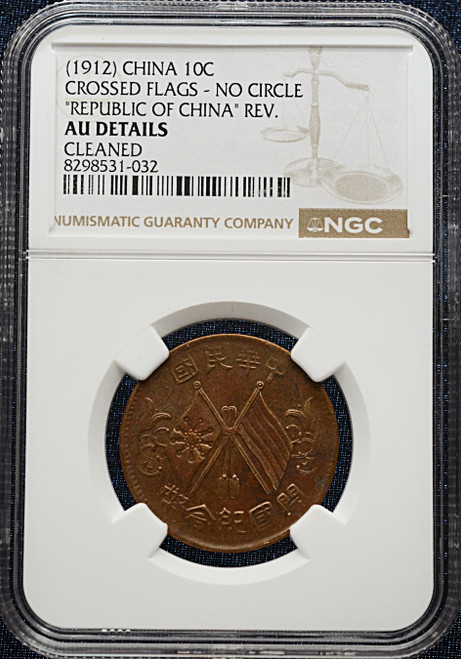
1905 China — Kiangnan Water Dragon 10 Cash AU DETAILS Environmental Damage.
A historically fascinating 1905 Kiangnan (Jiangnan) Water Dragon 10 Cash, struck during the final years of the Qing Dynasty and certified AU Details — Environmental Damage.
This coin belongs to the late-Qing period of rapid monetary modernization, when provincial mints across China were adopting Western-style, machine-struck technology while still operating under the authority of the imperial government.
The Kiangnan Mint
The coin was issued by Kiangnan Province, corresponding broadly to the Jiangnan region of southeastern China, and was struck at the Nanking (modern Nanjing) Mint.
The Nanking Mint had begun operating modern minting machinery in 1897, with equipment supplied by Heaton & Son of Birmingham, England. The establishment of modern machinery was part of the Qing government's broader attempt to standardize and modernize China's coinage.
This makes the coin an excellent representation of the meeting between traditional Chinese imperial symbolism and modern Western industrial technology.
The Imperial Water Dragon
The magnificent dragon dominates the reverse, facing forward with the flaming pearl beneath it.
The dragon was the ultimate symbol of imperial authority in Qing China, traditionally associated with the emperor himself. Its appearance on this coin was therefore a direct statement of the authority of the Qing state.
Yet the coin's modern manufacture and bilingual design tell another story.
The dragon of the ancient imperial tradition appears on a machine-struck copper coin using Western-style technology and English lettering:
KIANG-NAN
TEN CASH
The result is a fascinating snapshot of China during one of the final stages of its imperial monetary history.
The Meaning of the Inscriptions
The obverse combines Chinese and Manchu inscriptions, identifying the Guangxu reign, Kiangnan Province, the mint authority, and the denomination.
The reverse carries the English “KIANG-NAN / TEN CASH”, with the mint designation in Manchu at the sides and the imperial dragon at center. The Smithsonian's National Numismatic Collection likewise identifies the 1905 Kiangnan 10 Cash as a Guangxu-era Qing coin from Kiangnan Province, with the dragon on the reverse and English “KIANG-NAN / TEN CASH.”
The presence of English was particularly significant in this period, reflecting China's increasing interaction with foreign commerce and Western monetary practices.
A Coin From the Final Years of the Qing Dynasty
The date 1905 is historically important.
China was only six years away from the Xinhai Revolution of 1911, which would overthrow the Qing Dynasty and establish the Republic of China in 1912.
The Qing government was attempting to modernize the country while simultaneously facing enormous internal and external pressures. One of the government's major concerns was the chaotic state of China's currency, with numerous provincial mints producing different denominations and varieties.
Indeed, 1905 was a particularly important year for monetary reform. On August 22, 1905, the emperor approved plans for a central mint at Tientsin with branch mints at Nanking, Tientsin, Wuchang, and Canton, while seeking to restrict the expansion of other provincial mints.
This coin therefore comes from a fascinating moment when the Qing government was actively attempting to bring China's fragmented provincial coinage under greater central control.
The Problem With China's Copper Coinage
There is another fascinating piece of history behind these apparently humble 10 Cash coins.
Contemporary reports noted that many Chinese 10 Cash copper coins had an intrinsic value considerably below their stated denomination. Some were worth only around 3 or 4 cash, yet were forced into circulation at the 10 Cash value. This contributed to heavy discounting and monetary confusion.
The enormous quantities produced by China's provincial mints further complicated the situation.
Thus, this ordinary-looking copper coin is actually connected to one of the major economic problems confronting the late Qing government: how to create a reliable, standardized modern currency for a rapidly changing China.
AU Details — Environmental Damage
This example is certified AU Details with the NGC comment “Environmental Damage.”
The AU Details designation indicates that the coin retains substantial detail and evidence of limited circulation, but environmental exposure has affected the surfaces sufficiently to prevent a straight numerical grade.
For collectors, the coin remains desirable primarily because of its historical context, attractive dragon design, late-Qing date, and association with the Nanking Mint.
Coin Details
- Country: China
- Province: Kiangnan (Jiangnan)
- Period: Qing Dynasty / Imperial China
- Emperor: Guangxu
- Date: 1905
- Denomination: 10 Cash
- Type: Water Dragon
- Mint: Nanking (Nanjing)
- Reference: Y#138 / related Y#138.1 varieties
- Composition: Copper
- Obverse: Chinese and Manchu inscriptions
- Reverse: Imperial Dragon with pearl / “KIANG-NAN / TEN CASH”
- Grade: AU Details
- Comment: Environmental Damage
A Window Into the Twilight of Imperial China
The importance of this coin lies far beyond its denomination.
It was struck at a modern mint in Nanking, using technology that reflected China's attempt to enter the modern industrial and monetary world, yet it still carries the unmistakable dragon of the Qing emperor.
Only a few years later, the Qing Dynasty would disappear and the Republic of China would be established.
The Kiangnan Water Dragon 10 Cash therefore captures a remarkable moment in Chinese history — the ancient imperial system attempting to modernize just before the revolution that would bring it to an end.
A fascinating late-Qing provincial copper coin for collectors of Chinese Imperial coinage, dragon coins, provincial issues, and the monetary history of the final years of the Qing Dynasty.