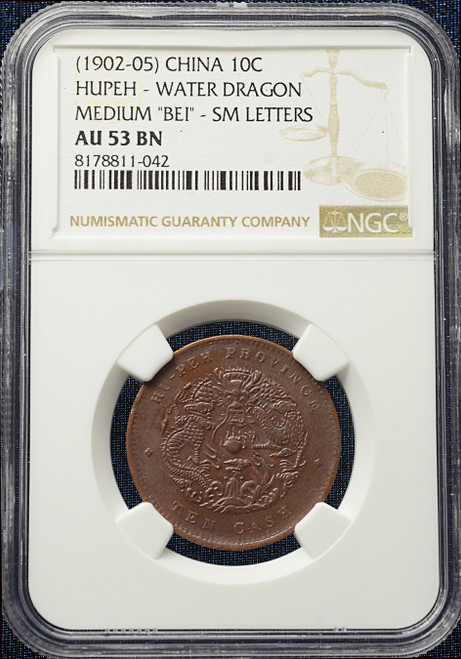
1902–1905 China Hupeh Water Dragon 10 Cash AU 50 BN
An attractive Hupeh Province Water Dragon 10 Cash, struck during the final years of the Qing Dynasty and graded AU 50 BN by NGC.
Dating from 1902–1905, this provincial issue belongs to an important period in Chinese monetary history when provincial governments were adopting modern machine-struck coinage while China was still under imperial rule.
Hupeh and the Wuchang Mint
The coin was produced for Hupeh Province, corresponding to modern-day Hubei Province, with the Wuchang Mint serving as its place of production. Modern minting equipment had been operating at Wuchang since 1895, reflecting the Qing government's efforts to modernize Chinese coin production.
The Hupeh 10 Cash was produced between 1902 and 1905, with a documented mintage of approximately 4,475,000 pieces for the standard type.
The coin's inscriptions combine Chinese and Manchu characters on the obverse with English on the reverse, reading “HU-PEH PROVINCE / TEN CASH.” This combination is a fascinating reflection of China's attempt to modernize its currency and participate more fully in an increasingly international monetary system.
The Water Dragon
The dragon is the defining image of the coin and one of the most powerful symbols of imperial China.
On Qing coinage, the dragon represented imperial authority, power, and the emperor himself. The dragon's association with the emperor makes these late-Qing dragon coins especially meaningful: they preserve the symbolism of an imperial dynasty that was only a few years away from its collapse.
The dragon is shown facing the viewer with the flaming pearl before it, surrounded by the English inscription identifying the province and denomination.
This combination of the traditional imperial dragon with a modern Western-style milled coin illustrates the fascinating tension of late Qing China — an ancient imperial government attempting to modernize while preserving its traditional symbols of authority.
A Coin From the Twilight of the Qing Empire
The historical context of this particular issue is exceptional.
The Guangxu Emperor nominally ruled China during this period, although he had been placed under effective confinement following the failure of the Hundred Days' Reform of 1898. The Qing government was struggling with foreign pressure, internal political instability, military reform, and demands for modernization.
Hupeh itself would soon become central to one of the most consequential events in modern Chinese history.
In 1911, the Wuchang Uprising erupted in Wuchang, initiating the chain of events that became the Xinhai Revolution. The revolution ultimately brought down the Qing Dynasty and led to the establishment of the Republic of China in 1912.
That means this coin was struck at the very same city whose revolutionary uprising would help end more than two thousand years of imperial rule in China.
For a collector, this gives the Hupeh Water Dragon an extraordinary historical connection: it is not simply a Qing provincial coin — it is a tangible survivor from the region that became the birthplace of the 1911 Revolution.
Why the Water Dragon Is Historically Important
This coin captures several major themes in Chinese history at once:
- Qing imperial rule
- Provincial monetary authority
- Modern machine-struck coinage
- Western influence on Chinese monetary design
- The imperial dragon as a symbol of Qing authority
- The modernization struggles of the late Qing
- Hupeh's connection to the Wuchang Uprising of 1911
The coin therefore represents the fascinating final chapter of imperial China — a period when traditional Chinese symbolism was being combined with modern industrial technology and Western-style monetary conventions.
NGC AU 50 BN
This specimen is certified AU 50 BN by NGC, indicating an About Uncirculated example with attractive brown coloration.
According to the NGC population information supplied for this coin:
- Grade: NGC AU 50 BN
- NGC Population at AU 50 BN: 77
- NGC Examples Graded Higher: 516
The population figures should not be interpreted as the total number of surviving coins, but they provide useful context for the certified population.
Coin Details
- Country: China
- Province: Hupeh (Hubei)
- Period: Qing Dynasty / Imperial China
- Emperor: Guangxu
- Date: 1902–1905
- Denomination: 10 Cash
- Type: Water Dragon
- Mint: Wuchang
- Composition: Copper
- Obverse: Chinese and Manchu inscriptions with central floral emblem
- Reverse: Imperial dragon with pearl; HU-PEH PROVINCE / TEN CASH
- Grade: NGC AU 50 BN
- NGC Population: 77
- Higher Grades: 516
A Remarkable Connection to the Fall of Imperial China
Few late-Qing provincial coins have such a compelling geographical connection to the end of the dynasty.
Struck at Wuchang in Hupeh, this coin was produced only a few years before the Wuchang Uprising of 1911, the event that set the Xinhai Revolution in motion and ultimately ended Qing imperial rule.
The coin's imperial dragon represents the old Qing order, while its modern machine-struck format reflects China's attempt to adapt to a changing world.
It is therefore a fascinating historical artifact from the twilight of the Qing Dynasty — struck in the very city where the revolution that ended the dynasty would begin.