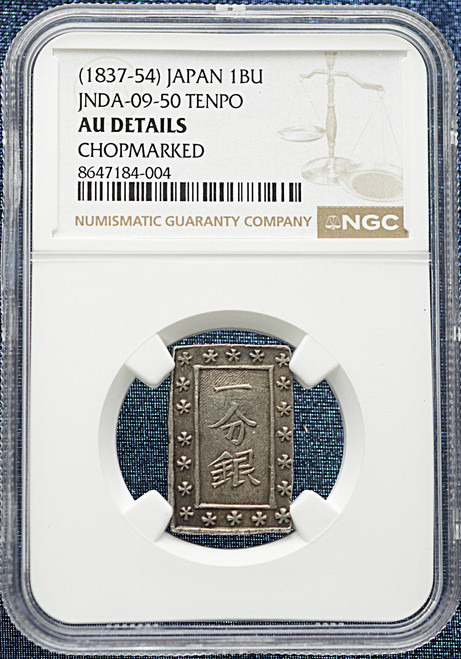
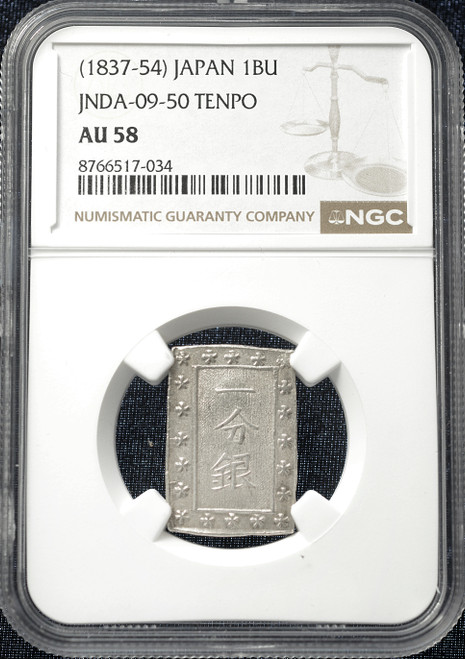
Japan — Tenpō (1837–1854) 1 Bu Silver (Ichibugin), JNDA 09-50, AU Details, Chopmarked.
The Tenpō 1 Bu (一分銀) was a rectangular Japanese silver denomination issued during the Tenpō era (1830–1844) and continuing into the later part of the Tokugawa shogunate. The type is generally dated 1837–1854 and is listed as JNDA 09-50. It represents one-quarter of a ryō, making it an important denomination in the traditional Japanese monetary system.
The coin is made of very high-purity silver, approximately .991 fine, with a standard weight of about 8.66 grams and dimensions of roughly 23 × 16.5 mm. Its irregular rectangular shape and hand-struck appearance are characteristic of Japanese Tokugawa-period silver coinage.
Design
The obverse features the distinctive Japanese characters and official markings arranged within a rectangular border surrounded by cherry-blossom (sakura) motifs. The principal inscriptions include 「一分銀」, meaning essentially "one bu silver." The reverse/other side carries the official mint and guarantee inscriptions, also enclosed by the characteristic floral border.
The edges are also distinctive, displaying patterned/reeded areas and small incuse star-like marks, features associated with this series of Japanese rectangular silver coins.
Historical significance
The Tenpō 1 Bu was introduced into circulation on January 13, 1838, during a period when the Tokugawa government was attempting to manage significant economic and monetary problems. The coin belongs to the monetary system of Edo-period Japan, before the Meiji Restoration and the adoption of modern Western-style coinage.
The recorded mintage for the standard 1837–1854 issue is approximately 78,916,556 pieces, so the basic type is not considered exceptionally rare. However, individual examples can become considerably more interesting to collectors because of condition, varieties, countermarks/chopmarks, striking characteristics, and eye appeal.
AU Details
The AU (Almost Uncirculated) Details designation indicates that the coin retains a substantial amount of its original detail and shows relatively limited circulation wear, but that the grading service has identified a condition issue that prevents it from receiving a straight AU numerical grade.
In this case, the important qualifier is "CHOPMARKED."
A chopmark is a merchant, money changer, or other privately applied countermark punched into a coin after its original manufacture. Chopmarked Asian silver coins are particularly interesting because the marks provide evidence of the coin's subsequent commercial circulation and authentication history. On a Japanese piece such as this, the marks should be considered part of the coin's later history rather than part of the original Tenpō design.
Toning and patina
The description "very nicely toned with a beautiful patina" is a strong positive from an aesthetic and collector standpoint.
After nearly two centuries, high-purity silver naturally develops surface coloration through exposure to air, humidity, handling, storage environments, and other factors. Attractive toning can produce shades ranging from gray and charcoal to golden, brown, blue, or iridescent hues. On an old Japanese silver coin, this natural patina can emphasize the raised characters, floral border, and surface texture while giving the piece an unmistakably historic appearance.
Importantly, natural toning should not automatically be confused with damage or cleaning. A coin with original-looking surfaces and attractive, undisturbed patina can be much more desirable aesthetically than a bright, recently cleaned example.
Overall collector appeal
This is an appealing example because it combines several desirable characteristics:
- Tokugawa/Edo-period Japanese coinage
- Tenpō 1 Bu silver denomination
- JNDA 09-50 attribution
- High-purity silver (~99.1%)
- 1837–1854 historical period
- AU-level details and strong remaining design detail
- Chopmarked surfaces documenting later circulation
- Attractive natural toning/patina
Please see the photographs and NGC certification for the exact variety, color, surfaces, and condition of the coin.