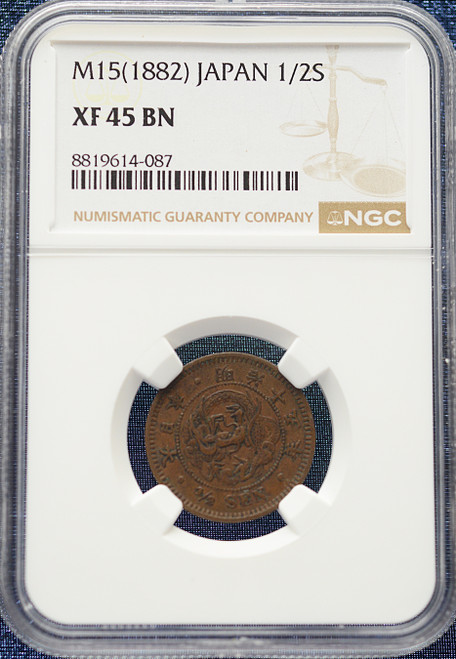
Japan 1 Sen — Meiji Year 17 (1884), NGC VF 30 BN
A historically interesting 1884 Japan 1 Sen, struck during Meiji Year 17 under Emperor Meiji. This period was one of the most transformative eras in Japanese history, as Japan rapidly modernized its government, economy, industry, and monetary system while adopting many Western-style institutions.
The 1 Sen was an important everyday denomination within Japan's new decimal currency system, in which 100 sen equaled 1 yen and 10 rin equaled 1 sen. The coin is struck in bronze and measures approximately 27.8 mm in diameter.
The design is especially characteristic of Japan's early Meiji coinage. The obverse features an entwined dragon surrounded by a beaded border, together with Japanese characters identifying Great Japan, the Meiji era and year, and the denomination “1 SEN.” The reverse displays the denomination within a decorative wreath. The Smithsonian's National Numismatic Collection identifies the 1884 example as a copper coin and translates the obverse inscription as “Year 17 of Meiji, Great Japan, 1 Sen.”
The 1884 issue had a mintage of approximately 53.7 million pieces. Although many examples were produced, well-preserved coins with attractive original surfaces are increasingly desirable to collectors of Japanese Meiji coinage.
This example is certified by NGC as VF 30 BN (Very Fine, Brown). The VF 30 grade indicates that the coin retains substantial design detail while showing the expected circulation wear of a coin that was used in commerce. The BN (Brown) designation reflects its brown coloration and copper/bronze appearance.
According to the NGC census information provided, only 5 examples are graded VF 30 BN, with 27 examples graded higher. This places the coin in a relatively small certified population at this grade level.
An appealing piece of 19th-century Japanese history, this 1884 1 Sen represents Japan's transition into a modern, internationally oriented economy during the remarkable Meiji era.