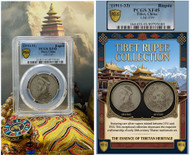
The Story Behind the Szechuan-Tibet Rupee: 1911–1933 Silver Rupee (L&M-359)
Posted by Harry Simonian on Oct 27th 2026
The Story Behind the Szechuan-Tibet Rupee: 1911–1933 Silver Rupee (L&M-359)
Category: Asian Numismatics | World Silver | Historical Coinage
Tags: Tibet Rupee L&M-359 PCGS XF45 Szechuan Silver Sichuan Mint Chinese Provincial Coins Tibetan Border Coinage
A Coin Born at the Crossroads of Empires
At the turn of the 20th century, the Himalayan borderland between China’s Sichuan province and the high plateau of Tibet was a crucial commercial route. Merchant caravans traversed mountain passes carrying brick tea, silk, and spices, trading across regions with vastly different monetary systems.
For decades, the dominant trade currency along the Eastern Himalayan frontier was the British Indian Rupee, featuring the portrait of Queen Victoria. To counter British economic influence in the region and supply a reliable, uniform silver medium for trans-Himalayan commerce, Chinese imperial authorities in Sichuan established a dedicated silver coinage starting around 1902 at the Chengdu Mint.
These coins—commonly referred to by collectors as Szechuan-Tibet Rupees—were modeled directly on the weight, purity, and dimensions of the British Indian Rupee to ensure immediate local acceptance among Tibetan and Sichuanese merchants alike.
Design Breakdown: An Intriguing Numismatic Blend
The design of the 1911–1933 Sichuan-Tibet Rupee (Cataloged as L&M-359 in Kann Lin & Ma’s definitive reference Illustrated Catalog of Chinese Gold & Silver Coins) reflects its unique geopolitical context:
Obverse: The Provincial Portrait
The obverse presents a profile bust inspired by the Qing Dynasty Emperor Guangxu, rendered in traditional regional attire with a structured cap and braided queue
Reverse: Floral Wreath & Sichuan Inscription
The reverse features an elegant, swirling floral collar enclosing four Chinese characters:
四川省造(Sichuan Sheng Zao — "Made in Sichuan Province")
The intricate border motif mirrors the decorative scrollwork of traditional Tibetan art and textiles, bridging Chinese regional authority with Himalayan cultural aesthetics
Production & Historical Timeline (1911–1933)
Following the fall of the Qing Dynasty in late 1911 and the founding of the Republic of China, production of the Sichuan Rupee continued at the Kangding (Tachienlu) and Chengdu mints well into the 1930s.
Because these coins served as working commercial money in harsh mountain environments, the vast majority experienced heavy circulation, rough handling, and cleaning. Finding an example that retains crisp design details, original surface integrity, and attractive natural cabinet toning is a prize for Asian coin specialists.
Technical Specifications & Collector Attributes
| Attribute | Details |
| Region / Issuing Authority |
Tibet / Sichuan Province, China |
| Date Range |
1911–1933 |
| Denomination |
1 Rupee |
| Catalog Reference |
L&M-359 |
| Certification |
PCGS XF45 (Gold Shield Holder with NFC Security) |
| PCGS Certification No. |
89795083 |
| Composition | Silver |
| Eye Appeal & Condition |
Moderate, honest wear with defined high-relief details and attractive peripheral toning |
Why This Example Stands Out
-
Certified PCGS XF45 Quality: Graded Extremely Fine 45 by PCGS, this coin shows light, uniform wear across the high points of the portrait and reverse leaves while preserving strong design definition and high visual contrast
-
Encapsulated Security: Housed in a state-of-the-art PCGS Gold Shield slab equipped with anti-counterfeiting NFC technology, offering full verification and peace of mind
-
Cross-Series Appeal: A key anchor piece that fits seamlessly into a collection of Tibetan regional issues, Chinese Provincial silver, or Asian trade coins.