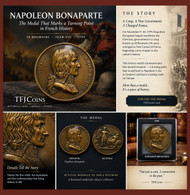
The Historical Context: The Coup of 18 Brumaire
Posted by Harry Simonian on Oct 27th 2026
The Historical Context: The Coup of 18 Brumaire
By late 1799, France was reeling from political instability, military setbacks, severe inflation, and widespread government corruption under the Five-Member Directory. Returning from his Egyptian campaign as a national hero, the 30-year-old Napoleon Bonaparte joined forces with political conspirators—most notably Emmanuel-Joseph Sieyès—to reform the government.
What began as a legal political maneuver quickly turned into a military takeover:
-
The Plan: Conspirators persuaded the Directory to resign and moved the legislature to Saint-Cloud under the pretext of an impending Jacobin plot, with Napoleon assigned to command the local troops for "protection."
-
The Climax: On 19 Brumaire, facing hostile lawmakers in the Council of Five Hundred who threatened to outlaw him, Napoleon’s troops, led by his brother Lucien Bonaparte, cleared the chamber at bayonet point.
-
The Outcome: The remnant legislature dissolved the Directory and created an executive triumvirate: the French Consulate. As First Consul, Napoleon concentrated absolute power in his own hands, transitioning France from a fragile republic toward a centralized empire.
To celebrate this transition, the regime commissioned commemorative medals to control the narrative: presenting Napoleon not as a military dictator, but as the restorer of peace, victory, and republican order.
Design & Neoclassical Iconography
Designed by the master engraver Louis-Michel Petit, this 51 mm heavy-module bronze medal exemplifies the French Neoclassical style—drawing heavily on Roman imperial design to emphasize strength and legitimacy.
Obverse (Front)
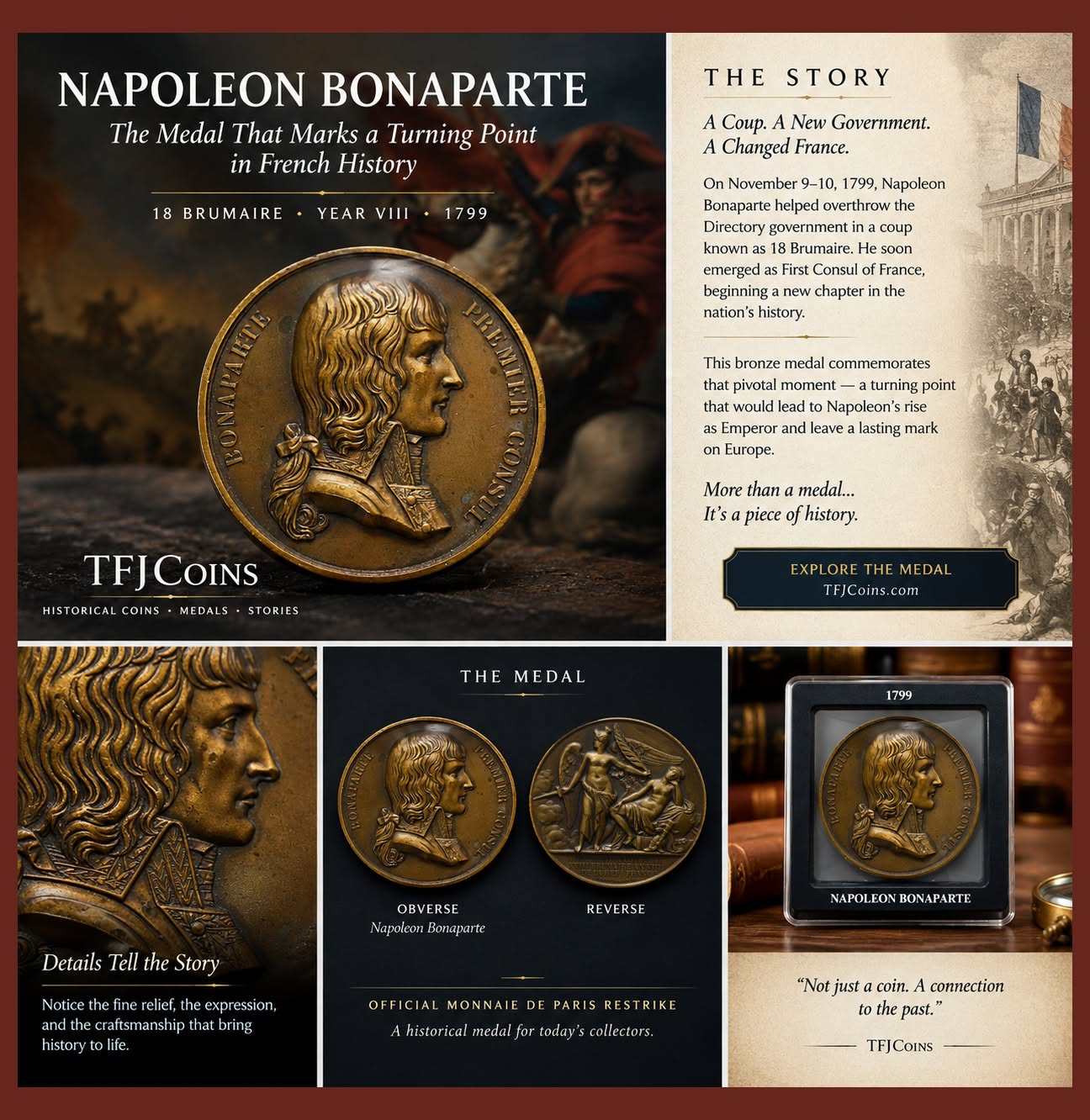
Features a sharp, high-relief profile bust of Napoleon Bonaparte rendered in his military uniform as First Consul. Unlike later imperial coinage depicting him wearing a Roman laurel wreath, this early portrait captures Napoleon at the dawn of his political ascendancy—youthful, decisive, and commanding.
Reverse (Back)
The reverse presents an allegorical composition packed with symbolism:
-
Winged Victory: Stands holding a sword and a palm frond, symbolizing military triumph paired with civic peace.
-
Liberty & Trophy of Arms: The seated figure of Liberty leans against a detailed collection of captured weapons and armor, signaling that the Republic’s freedom was secured through military strength.
-
Exergue Inscription: Reads AVENEMENT AU CONSULAT / XVIII BRUMAIRE AN VIII / DE LA REPE FRANCAISE (Accession to the Consulate, 18 Brumaire Year 8 of the French Republic).
-
Artist Signature: Flanked by PETIT INV ET F. (Petit Invenit et Fecit — "Invented and Made by Petit").
Edge Marks & Authenticity
Unlike struck currency intended for circulation, art medals minted by the state were restruck across different eras using original archival dies maintained by the Monnaie de Paris.
To distinguish official state restrikes from contemporary originals or unauthorized copies, the Paris Mint began stamping standard foundry hallmarks on the edge of its medals in the 19th century:
-
Cornucopia (Horn of Plenty): The official mark of the Monnaie de Paris, guaranteeing its production at the national mint.
-
BRONZE Stamp: Clear incuse stamping denoting metal purity and composition.
Maintained in pristine, uncirculated mint condition, this 74.7-gram bronze medal retains its original deep luster, offering collectors a heavy, museum-quality piece of Napoleonic history.