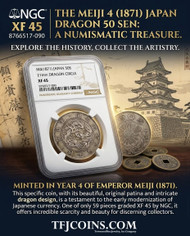
1871 Japan Meiji 4 (M4) 50 Sen Silver Coin – 21mm Dragon Circle Variety – NGC XF45
Posted by Harry Simonian on Oct 29th 2026
1. Historical Context: The Birth of Modern Japanese Currency
To understand the true importance of this coin, your readers need to know what was happening in Japan in 1871.
-
The Fall of the Shogunate: Just a few years prior, in 1868, the Meiji Restoration overthrew the Tokugawa Shogunate, ending centuries of feudal isolation (Sakoku) and restoring imperial rule under Emperor Meiji.
-
Monetary Chaos to Modernization: Before Meiji, Japan’s monetary system was a complex, fragmented web of feudal clan notes (hansatsu) and diverse gold/silver/copper weight-based coinages (such as oban and koban). To trade competitively with Western powers, Japan desperately needed a unified, decimal-based national currency.
-
The New Currency Act of 1871: Formally enacted by the Meiji government (Daijō-kan), this act officially introduced the Yen (divided into 100 Sen and 1,000 Rin), signaling a massive ideological and structural shift toward Western economic standards.
2. The Technological Marvel: The Osaka/Tokyo Mints and Western Machinery
The striking of these early Meiji silver coins was a physical embodiment of Japan's slogan Fukoku Kyōhei ("Enrich the Country, Strengthen the Military").
-
The Hong Kong Mint Machinery: The machinery used to strike these early dragon coins didn't actually originate in Japan. The Japanese government purchased the entire defunct Hong Kong Mint from the British colonial authorities in 1868, shipping the heavy steam-powered coining presses, rolling mills, and assay equipment to Osaka.
-
Intricate Symbolism: The coin bridges traditional Japanese authority with Western minting technology. The fierce, scaled Japanese dragon on the obverse represents imperial power, celestial protection, and modern statehood, encircled by the distinctive beaded border. The reverse features the sacred Chrysanthemum Seal (the Emperor’s crest), flanked by paulownia and chrysanthemum wreaths, alongside a brilliant radiant sunburst.
3. Numismatic Significance & The "21mm Dragon Circle" Variety
While standard 1871 (Meiji 4) 50 Sen coins are heavily collected, the 21mm Dragon Circle variety (KM# Y#4a.2 / JNDA 01-13A) stands out as a major point of interest for advanced specialists:
-
The Die Variation: During the early minting phases, minor adjustments were made to the size of the inner beaded ring enclosing the dragon. While the more common variety features a tighter inner circle (approx. 19mm), this scarce variant expands the inner beaded circle to 21mm.
-
Why Specialists Care: Because dies were hand-punched and frequently modified during the chaotic startup years of the Osaka Mint, distinct die marriages and ring variations occurred over short production runs. Variety collectors actively hunt for the 21mm variant because its survival rate in high condition is noticeably scarcer than its 19mm counterpart.
4. Rarity, Population, and Grading (NGC XF45)
An XF45 (Extremely Fine) grade from NGC places this specimen in a very desirable tier for 19th-century world silver:
-
Survivor State: Most of these coins saw active commercial circulation during a period of intense industrial growth in Meiji Japan, meaning they frequently turn up heavily worn, cleaned, or damaged. Finding one that has escaped harsh cleaning, retaining its original surfaces, light cabinet toning, and crisp details on the dragon's scales is uncommon.
-
The Census Context: With under 60 examples certified at the XF45 level by NGC (and roughly 200 total higher grades globally), this coin occupies a sweet spot. It is scarce enough to give the collector true pride of ownership, yet accessible enough not to cost thousands like a Mint State-70 rarity.
-
The Toning Factor: Natural silver toning (such as the "Sunset Gold" or amber rim patination often found on older NGC holders like the Standard Brown Label) adds significant aesthetic and financial premiums. Natural album toning acts as a fingerprint of time, proving the coin has aged undisturbed for over 150 years.
Suggested Blog Post Subheading Ideas:
-
From Feudalism to Fineness: How the 1871 50 Sen Modernized Japan
-
Decoding the Dragon: Inside the 21mm Beaded Circle Variety
-
A Survivor of the Meiji Restoration: Why NGC XF45 Certified Japanese Silver Matters