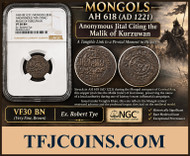
AH 618 (AD 1221) Mongols – Anonymous Jital Citing the Malik of Kurzuwan – VF30 BN – Ex. Robert Tye
Posted by Harry Simonian on Nov 2nd 2026
A Coin Struck in the Shadow of the Mongol Empire: The 1221 Jital of Kurzuwan
AH 618 (AD 1221) | Anonymous Jital | Malik of Kurzuwan | NGC VF30 BN | Ex. Robert Tye
A Small Coin from a Turning Point in History
Some coins tell the story of a king. Others tell the story of an empire. And occasionally, a coin preserves a moment when an entire city was fighting for its survival.
This medieval copper Jital belongs to that last category.
Struck in AH 618 (1221 AD), this anonymous issue is associated with the city of Kurzuwan during the Mongol invasion of Central Asia. It dates to the period when the armies of Genghis Khan were rapidly expanding westward, bringing established kingdoms and local authorities under extraordinary military pressure.
Today, this modest copper coin offers collectors a tangible connection to one of the most consequential periods in medieval history.
The Mongol Advance into Central Asia
During the early 13th century, the Mongol Empire expanded at an extraordinary pace under the leadership of Genghis Khan.
Following the conflict with the Khwarazmian Empire beginning in 1219, Mongol forces advanced through important cities and trading centers across Central Asia and Persia.
The invasion dramatically disrupted existing political structures, commerce, and everyday life. Cities that had once operated under established rulers suddenly faced military occupation, siege, or destruction.
Kurzuwan became part of this turbulent chapter.
The coinage attributed to the Malik of Kurzuwan is particularly interesting because it is believed to have been produced during the Mongol siege of the city in 1221.
The Mystery of the Malik of Kurzuwan
One of the most fascinating aspects of this issue is its inscription.
The coin bears the Arabic title Al-Malik, meaning "The King" or "The Sovereign," together with the name Kurzuwan and an Islamic religious inscription.
However, the precise identity behind the title remains uncertain.
It may refer to a local authority exercising power during the crisis, or it may carry a religious meaning referring to God as the Supreme King.
This uncertainty is part of what makes the coin historically compelling. Unlike many medieval issues that clearly identify a reigning monarch, this anonymous coin reflects a period when traditional political authority was under extraordinary pressure.
The inscription preserves the name of a place and a title, but leaves us with questions about the people who produced it.
A Rare Glimpse into Medieval Siege Coinage
Coins produced during military sieges are particularly interesting to numismatists.
When normal political and economic systems are disrupted, local authorities may need to maintain commerce and provide a circulating medium for everyday transactions.
The Kurzuwan Jitals are considered among the identifiable siege-related coin issues of the medieval Islamic world.
Their existence provides evidence of local monetary activity during a period of military crisis.
It is a remarkable thought that while armies were moving across the region, coins such as this were still being struck and circulated.
The Coin Presented
This example is certified by Numismatic Guaranty Company (NGC) as:
-
Date: AH 618 (1221 AD)
-
Ruler: Anonymous, citing the Malik of Kurzuwan
-
Denomination: Jital
-
Metal: Copper
-
Grade: VF30 BN (Very Fine, Brown)
-
Provenance: Ex. Robert Tye
-
NGC Certification: 8440267-023
The coin retains its medieval character, with its Arabic inscriptions and distinctive circular design visible on both sides.
Its certified grade and historical attribution make it an appealing example for collectors interested in medieval Islamic coinage and the history of the Mongol Empire.
An additional point of interest is its provenance: Ex. Robert Tye, associated with the important reference work Jitals: A Catalogue and Account of the Coin Denomination of Daily Use in Medieval Afghanistan and North West India (1995), co-authored with Monica Tye.
More Than a Piece of Copper
More than eight centuries have passed since this coin was struck.
The political boundaries of the region have changed, dynasties have disappeared, and the Mongol Empire itself has become part of history.
Yet this small copper Jital survives.
It reminds us that coins are not simply objects of monetary exchange. They are historical records, carrying inscriptions, political messages, religious beliefs, and traces of the societies that produced them.
For collectors of medieval coinage, this anonymous Jital offers something particularly meaningful: a direct connection to a city caught in the path of the Mongol expansion.
At TFJ Coins, we believe every historical coin has a story worth preserving. Sometimes the smallest coins carry the biggest stories.
TFJ Coins | Historical Coins & Medals
Preserving History, One Coin at a Time.