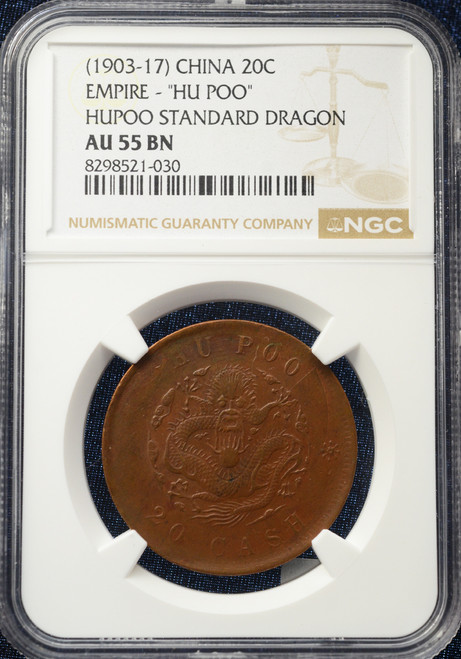
China Empire — Hu Poo Standard Dragon 20 Cash, 1903–1917
A handsome Qing Dynasty Hu Poo Standard Dragon 20 Cash, graded MS 61 RB by NGC.
This important late-Qing copper issue represents China's transition toward modern, machine-struck coinage during the final years of the imperial dynasty. Catalogued as Y#5, the type was issued beginning in 1903 and continued in related form through 1917.
The Meaning of “HU POO”
The words “HU POO” on the reverse are the historical English transliteration of 戶部 (Hùbù), the Board of Revenue, one of the principal ministries of the Qing imperial government.
The inscription therefore identifies the coin with the central Qing monetary authority. This is particularly significant because the Qing government was actively attempting to modernize China's fragmented monetary system in the final years of imperial rule.
The use of English lettering — “HU POO / 20 CASH” — alongside traditional Chinese and Manchu inscriptions is itself a fascinating reflection of this period of modernization and China's increasing interaction with the international monetary system. The reverse features the imperial dragon and pearl, while the obverse carries the traditional Qing inscriptions identifying the Guangxu Emperor and the monetary authority.
The Imperial Dragon
The magnificent dragon dominating the reverse is one of the defining symbols of Qing imperial coinage.
In traditional Chinese culture, the dragon represented imperial authority, power, strength, and the emperor himself. On this coin, the dragon and flaming pearl preserve the unmistakable visual identity of the Qing state at a moment when the dynasty was approaching the end of its 267-year rule.
This gives the coin an especially compelling historical context: it was produced during the final years of the Qing Empire, only a few years before the 1911 Revolution brought the dynasty to an end and China entered the Republican era.
China's Final Years of Imperial Coinage
The early 20th century was a period of extraordinary change in China.
The Qing government was attempting to modernize its monetary system and increasingly adopted Western-style machine-struck coinage, replacing or supplementing the traditional cast cash system that had dominated Chinese monetary history for centuries.
The Hu Poo Standard Dragon 20 Cash is an excellent representation of this transition. Its large milled planchet, standardized denomination, dragon design, and bilingual English inscription demonstrate the movement toward a more modern national monetary system. The coin therefore stands at the crossroads between traditional imperial China and the modern monetary era.
The Standard Dragon Type
This is the Standard Dragon variety of the Hu Poo 20 Cash.
The principal type is catalogued as Y#5, while related varieties include a version with a central rosette and a 1917 Wuchang restrike. Numismatic references note that the 1917 restrike was produced from unused dies prepared in 1903 and can be distinguished by differences in the dragon's details.
For collectors, this makes the Hu Poo series particularly interesting because apparently similar coins can represent different periods and production circumstances during the final years of the Qing monetary system.
NGC MS 61 RB
This specimen has been certified MS 61 RB (Red Brown) by NGC, confirming an uncirculated example with attractive remaining original copper coloration.
According to the NGC population information provided for this coin:
- Grade: NGC MS 61 RB
- NGC Population at MS 61 RB: 5
- NGC Examples Graded Higher: 34
While the population does not establish the coin as an absolute rarity, the combination of Mint State preservation and Red Brown designation makes this a desirable example for collectors of Qing Dynasty copper.
Coin Details
- Country: China
- Period: Qing Dynasty / Empire of China
- Emperor: Guangxu
- Date: 1903–1917
- Denomination: 20 Cash
- Type: Hu Poo Standard Dragon
- Reference: Y#5
- Composition: Copper
- Design: Imperial Dragon and Pearl
- Reverse Legend: HU POO / 20 CASH
- Grade: NGC MS 61 RB
- NGC Population in MS 61 RB: 5
- Higher Grades: 34
A Coin From the Twilight of the Qing Dynasty
This coin is more than a copper denomination—it is a tangible survivor from the final chapter of China's imperial monetary history.
The combination of the Qing imperial dragon, the Hu Poo government designation, traditional Chinese and Manchu inscriptions, and the English “HU POO / 20 CASH” makes this a fascinating representation of China's attempt to modernize while still under imperial rule.
Struck only a few years before the fall of the Qing Dynasty in 1911, the Hu Poo Standard Dragon captures a remarkable moment in Chinese history: the old imperial monetary system meeting the modern world.
An attractive NGC MS 61 RB example of an important late-Qing type, ideally suited for collectors of Chinese Imperial coinage, Qing Dynasty history, dragon coinage, and the monetary transition that preceded Republican China.