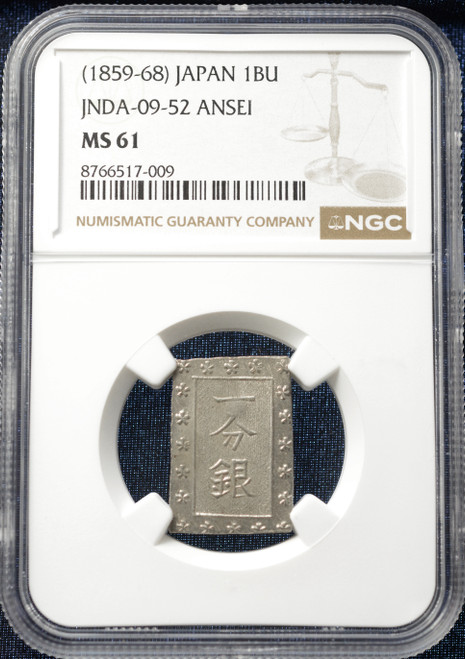
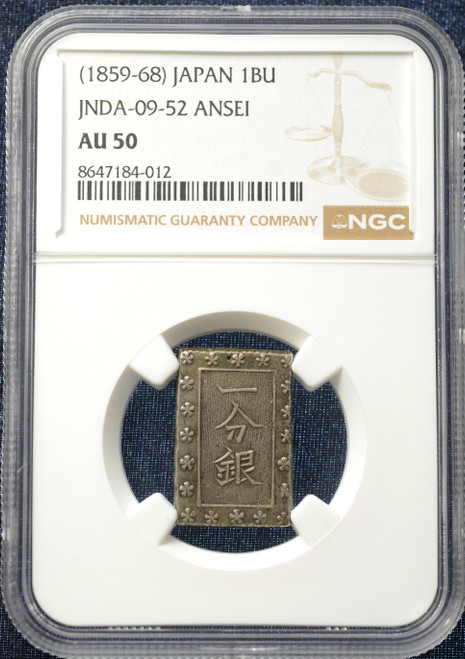
Japan — Ansei 1 Bu Silver (Ichibugin), 1859–1868
A beautiful Ansei 1 Bu Silver (Ichibugin) from Japan's late Edo period, dating to the Ansei era (1859–1868) and catalogued as JNDA-09-52.
Certified MS 62 by NGC, this example represents a well-preserved specimen of one of the most recognizable silver denominations of Japan's final shogunate era.
The Ansei Ichibugin
The 1 Bu (一分銀) was an important denomination within the traditional Japanese monetary system of the Tokugawa shogunate. One Bu represented one-quarter of a Ryo, making the coin part of the complex gold-and-silver currency system used throughout Japan before the adoption of the modern yen.
Unlike modern round coins, the Ansei Ichibugin has a distinctive irregular rectangular shape, characteristic of Japanese silver currency of the period. It contains approximately 8.62 grams of .873 fine silver.
The coin is generally referred to as an Ichibugin, literally meaning “one Bu silver.”
The Meaning of the Inscriptions
The reverse prominently displays the three characters:
一 分 銀
meaning “One Bu Silver.”
The opposite side carries the traditional markings associated with the Ginza, the government-controlled silver mint, together with the distinctive 20 cherry-blossom border.
One particularly fascinating feature of the design is that one of the surrounding cherry blossoms is intentionally inverted. The detailed inscriptions and countermarks were part of the system used to identify and guarantee the silver currency.
A Coin From the Final Years of the Tokugawa Shogunate
The historical setting of this coin is extraordinary.
The Ansei era falls within the final decade of the Tokugawa shogunate, when Japan was undergoing enormous political and economic change.
In the 1850s and 1860s, Japan was being forced to open to increasing foreign trade and diplomatic contact after centuries of relative isolation. The arrival of Commodore Matthew Perry's American expedition in 1853 and the subsequent treaties with Western powers placed enormous pressure on the Tokugawa government.
By the time this coin circulated, Japan was approaching one of the greatest political transformations in its history.
Only a few years after the Ansei era, the Tokugawa shogunate would collapse during the Meiji Restoration, ending centuries of samurai government and returning political authority to the imperial government.
Thus, this small piece of silver circulated during the final chapter of Japan's feudal monetary system.
Traditional Japanese Money
The Ichibugin is especially fascinating because it belongs to a monetary system completely different from the modern yen.
The traditional currency was based around the Ryo, Bu, Shu, and mon denominations, with gold, silver, and copper fulfilling different roles. The 1 Bu occupied an important position within this system as a fractional silver denomination.
The rectangular shape, hand-struck appearance, Japanese characters, and intricate border of cherry blossoms make the coin immediately recognizable as a product of pre-Meiji Japan.
NGC MS 62
This example has been certified MS 62 by NGC, placing it firmly in the Mint State category.
According to the NGC population information supplied for this coin:
- Period: Ansei Era, 1859–1868
- Denomination: 1 Bu / Ichibugin
- Reference: JNDA-09-52
- Metal: Silver
- Grade: NGC MS 62
- NGC Population at MS 62: 193
- Higher Grades: 555
The population figures represent certified examples and should not be interpreted as the total surviving population.
Coin Details
- Country: Japan
- Period: Late Edo / Tokugawa Shogunate
- Era: Ansei
- Date: 1859–1868
- Denomination: 1 Bu (Ichibugin)
- Composition: .873 Silver
- Weight: Approximately 8.62 g
- Shape: Irregular rectangular
- Reference: JNDA-09-52 / C#16a
- Grade: NGC MS 62
A Fascinating Survivor From Old Japan
The Ansei 1 Bu is more than a silver denomination. It is a tangible piece of the old Japanese monetary system that existed immediately before the Meiji transformation.
Struck in the final years of the Tokugawa shogunate, it circulated at a moment when Japan was beginning to move from centuries of feudal isolation toward the modern nation-state.
With its distinctive rectangular form, traditional Japanese inscriptions, cherry-blossom border, and silver composition, the Ansei Ichibugin offers collectors an unusually direct connection to the final years of Edo-period Japan.
An attractive NGC MS 62 example of an important and historically fascinating Japanese silver denomination.