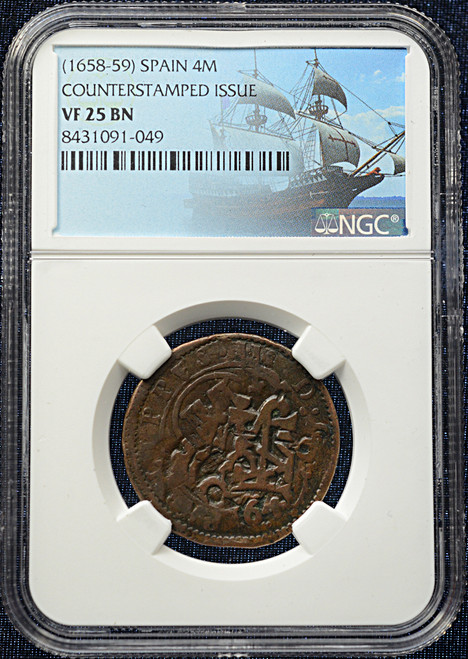
(1651–1652) Spain 8 Maravedis (Counterstamped Issue) | NGC VF 30 BN – Burgos Mint / Clear 1622 Host Date
Item Overview
An exceptional condition rarity featuring incredible diagnostic clarity! Facing severe state debt under King Philip IV, the Spanish Crown launched massive emergency copper re-tariffing campaigns in 1651–1652, recalling circulating copper coins to counterstamp them as 8 Maravedis (resellado).
This certified piece carries the official Burgos pedigree attribution on its NGC holder. Most notably, it exhibits an exceptionally bold counterstamp punch displaying a clear "1622" date paired with the "B" hallmark for the Royal Mint of Burgos directly in the center. Certified VF 30 BN by NGC, it ranks near the absolute top of the official population report.
Specifications & Certification
| Attribute | Details |
| Certification | NGC (Numismatic Guaranty Company) |
| Grade / Color | VF 30 BN (Very Fine 30, Brown) |
| Pedigree / Mint | Burgos (B Mintmark) |
| Counterstamp Date | 1622 / 1651–52 Series (Clear date in punch) |
| Issuer / Country | Kingdom of Spain |
| Monarch | King Philip IV (Felipe IV) |
| Denomination | 8 Maravedis (8M / VIII) |
| Type | Official Royal Counterstamp (Resello) |
| Metal | Copper |
NGC Census & Condition Rarity
Full date clarity on 17th-century Castilian re-stamps is notoriously scarce due to uneven punches and heavy circulation. This specimen represents one of the finest surviving examples:
-
Total Graded by NGC: 2
-
Graded VF 30 BN: 1 (This exact specimen)
-
Graded Higher: 1
Rarity Highlight: With only a single specimen graded higher in the entire NGC population report, this coin is a premier tier-1 acquisition. The distinct B hallmark and fully readable 1622 numerals make it an ideal centerpieces for counterstamp and Spanish Colonial specialists.
Historical Significance
-
-
The Royal Mint of Burgos: Operating in northern Castile, Burgos produced far fewer counterstamped coppers than Madrid or Segovia, making the B hallmark highly sought after by mint-mark collectors.
-
The 1651–1652 Crisis: By punching official royal crowns, dates, and denomination marks directly onto older coppers, Philip IV's treasury re-valued currency instantly to fund European military campaigns.
-